Showing posts with label Artists. Show all posts

Tuesday, 8 April 2014

Exhibition Ideas

So its come round again! My final exhibition for year 1 will be in a few weeks time and I dont know where the year has gone...people said it would go fast but I didnt realise just how fast! Ive been having a few ideas on how im going to present my work as it was what i wanted to do for my show and listen a couple of weeks ago. I want to be a lot braver and do something larger and create more of an emmersive experience. My idea for this came from my workshop with Ella where she said 2D can create volume and a physicality which id never really considered before as id hated any 2D work with a passion, but as im considering the transition between two states i want to use 2D in a way that creates physicality and makes a type of sculptural work. Ive also wanted to use fabric for a while to mimic the state of fluidity compared to the materials solid qualities. Ive thought a bit about hanging a long roll of fabric over the bars at the top of the studio in various different ways that will make the viewers move around or underneath the material, but the problem im having is how and which images to print. I may create one long continuous repetitive pattern from the photographs ive taken of my sculptural work but i liked my use of screenshots from my show and listen, for this i wouldnt know how to stretch this onto a long piece of fabric. Anyway, ive been looking at some artists that use fabric and paper in a more physical and sculptural way...

Karla Black


http://ilikethisart.net/?p=11633
Work from her oeuvre.
“WHEN I’M NEARLY FINISHED making a work, I ask myself, “If this was a painting, would it be a good painting?” If I decide that the answer is yes, then I’m done. I use impermanent and raw materials like paper, polythene, plaster powder, and cosmetic products in my sculptures not because they easily change and decay but because I want the energy, life, and movement that they give. I would much rather have the sculptures stay exactly as they are the moment I finish making them. But I also know that if my first priority were to preserve the work forever, or for as long as possible, then I’d use stone, metal, or wood. But those materials don’t have the qualities I want. It’s a double bind.
My work needs to occupy the kind of large rooms that Modern Art Oxford has to offer, and it needs to enter into the institutional realm in order to become what it really is. The work is both a protest and a compromise at the same time. While it tries to dismantle the demands of being permanent, transferable, and stable, as required by most art institutions, it also physically and sculpturally negotiates within those conditions and reaches compromises that allow it to exist in those places.
I prioritize material experience over language as a way of learning and understanding. The physical human experience that comes from the inside out precedes language and is most absorbent for us, most unself-conscious, when we are fully in it and therefore completely unaware of any image of ourselves, of how we think we might look to others. The moment we become aware of ourselves from the outside in, as an image that others can see, or as a subject that holds a particular meaning, symbolic or otherwise, then we split from that primary experience of the physical world and must think. Traditionally, painting offered an optical escape from this world, by providing a window onto another. Sculpture can offer some sort of escape, too, through an actual engulfment in the physical.
In art school critiques, my classmates sometimes said my work looked “feminine” and “domestic.” I could see what they meant, but that was never my intention and still isn’t. I like pink, and if someone wants to say that’s because I’m a woman, then perhaps it is. I’m interested in those kinds of cultural judgments that come from the outside. In the end, I decided to just do what I want to do, to use the materials and colors I want to use, because I want to enjoy making the work as much as I can. It’s hard enough to make something that’s any good, so you may as well start with some sort of self-indulgence.
I felt that judgments of femininity or domesticity were derogatory and that they meant, perhaps, that the work was not very good or not serious. (I still wonder why I thought and, to a certain extent, still think that. Is it because of some residual misogyny in myself?) There are a lot of men who use pink—Franz West, for instance. But who says that his work looks feminine or domestic?
Why is it only women’s art that is gendered? I was recently asked, “How do you think your work would differ if you were a man?” Would anyone ever ask a man, “What would your work look like if you were a woman?”” – as told to LAUREN O’NEILL-BUTLER for artforum.

Alice Channner


Claire Barclay


Tuesday, 4 February 2014

Random

Joey Holder


Jonathan McCabe


into the colorflow from Jonathan McCabe on Vimeo.

'Three processes interact to make this animation. A spontaneous differentiation due to a multi-scale Turing instability causes the development of dots and lines of various colors. Each color is also a movement, leading to a compressible flow which smears and obliterates the dots and lines. The third process is an overall exponential growth or inflation. Small structures expand, and the Turing instability causes sub-structures to form.'


Jin Han Lee


Usually i really hate paintings, canvas, landscapes and just paint in general but i really love these. I love how futuristic they look and mix abstract with realist images of natural landscapes.

Ben Wheele


Bernhard Willhem


Joey Holder


Mary Katrantzou and Joey Holder Mash Up


I was recently told about Joey Holders work just on the basis that her use of pattern and texture seemed to be similar to mine, it wasnt till i read a few descriptions that i found a lot of her context relates to me too although hers is a lot more technical. The basis of her work is looking at the correlation between organic and artificial forms using a series of abstractions to create hybrids. Her work looks deeply into subjects of biology, nanotechnology and natural history creating fragmented patterns that clash against automated representations, each trying to grab the viewers attention.I love her use of hyper anestheticisation and creating a parallel between the forms she uses.

Her work is a mix of sculpture, painting, graphics and video and ive fallen in love with the way she mashes them up together in such a clever way. My work recently has been looking a lot more into this idea of mixing natural forms with artificial to create a blurred line and make a new formless shape that has some hints of recognition. A small quote i took from her website has helped me understand my own work a little better, ' it may suggest some particular function or form but remains elusive through odd displacement'. I like the idea of the function of the formless shape to be hard to pin down and to recognise if its fictional or a highly detailed image of something not many people understand. Which for myself, ive found that ive been doing this with Joeys work, i can never truly tell whats been manipulated or just a process of real layered images.

she eludes to the idea of technology in a way id like to also try, instead of presenting images on a canvas or blank screen, she creates screen shots showing open windows on familiar well known programs.

Saturday, 1 February 2014

Harrison and Wood Live Lecture


These are a couple of videos i took in the lecture, they arent too clear so ive taken some from youtube. By far my favourite is 3 legged!


Monday, 30 September 2013

Collage and Assemblage

Collage (From the Frenchcoller, to glue) is a technique of an art production, primarily used in the visual arts, where the artwork is made from an assemblage of different forms, thus creating a new whole.
A collage may sometimes include newspaper clippingsribbons, bits of colored or handmade papers, portions of other artwork or texts,photographs and other found objects, glued to a piece of paper or canvas. The origins of collage can be traced back hundreds of years, but this technique made a dramatic reappearance in the early 20th century as an art form of novelty.
The term collage derives from the French "coller" meaning "glue".[1] This term was coined by both Georges Braque and Pablo Picasso in the beginning of the 20th century when collage became a distinctive part of modern art.[2]

When I think of collage, the artists or movement I primarily think of is the Dada movement. They used a lot of collage pieces of literature, illustration using what materials were around as this was shortly after the first war where make do and mend was the main thought.

I also think of the obvious well known artists who use forms of collage (apart from re working used materials) such as Pablo Picasso who created his own images then cut up and reworked them. Collage like this I really dont like, it just looks so dated and arts and crafts type thing that many people do. Although, from this research ive really found a new avenue for collage that Id not really looked at before thats fresh and more interesting to me.

Julien Pacaud 'The Operator'

I really love the contrast between old and new with collage, contrasting black and white with bright graphic lines and marks, contrasting dreamy lines with sharp edges.Theres something really nice about how crisp the lines are when cutting out shapes and layering them over other images. I like the surrealism element or an other worldly type landscape that seems so alien but also familiar.


Ben Giles 'Mystery Jets'

From researching work like this just now Ive realised a lot of my research from previous work has been a form of collage, because its not the obvious collage of cutting up paper and layering, it still is another type of collage. I like how Ben has involved different mediums to mix up the textures and materials, this adds another dimension and a whole new way of using collage. 


Assemblage

I did a lot of research into assemblage in my first year of college and really enjoyed it as I got to rummage around in skips and my house for materials I could rework. I think from this I really learnt how to recycle with my work and spend the least amount of money as possible! I researched artists such as Mark Dion who likes to collect and collate his work very precisely in a very scientific way. I really liked his Cabinet of Curiosities as its a different spin on assemblage compared to piecing all the parts together.


Saturday, 7 September 2013

I Don't Like To Admit It But...

...My work closely relates to fashion, I dont know why I dont like admitting this! I dont necessarily like 'trends' or make patterns and work with patterns and fabric, but I like how materials interact with the body and change its perception which you could say...is clothing. ARGH! I battled with this a lot during my FMP at college and really wanted to avoid fashion and design at all costs, I really discovered a different type of 'wearable art' that Id never seen before that kind of blurs the line between being wearable and sculpture.

I do reference a lot of fashion in my work but the end product is far from clothing id say...but this does give me another area of research that I enjoy. Heres some fashiony artists Ive been looking at recently, their material manipulation, subject matter and how they work around the body I find really interesting.

Vanessa Schindler


Monday, 12 August 2013

Imme Van Der Haak


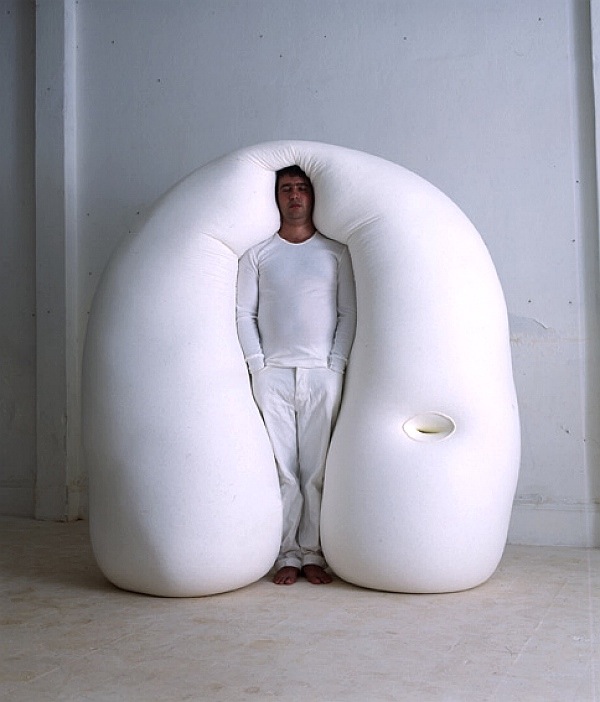
Ernesto Neto

I remember seeing one of these images during my research for the FMP but couldnt find out who it was by. It really relates to the work I was doing and is another avenue my idea could of gone down to make it more interactive which was my first intention for my work but you always somehow stray from that.