Wednesday, 13 March 2013

Skin and Body


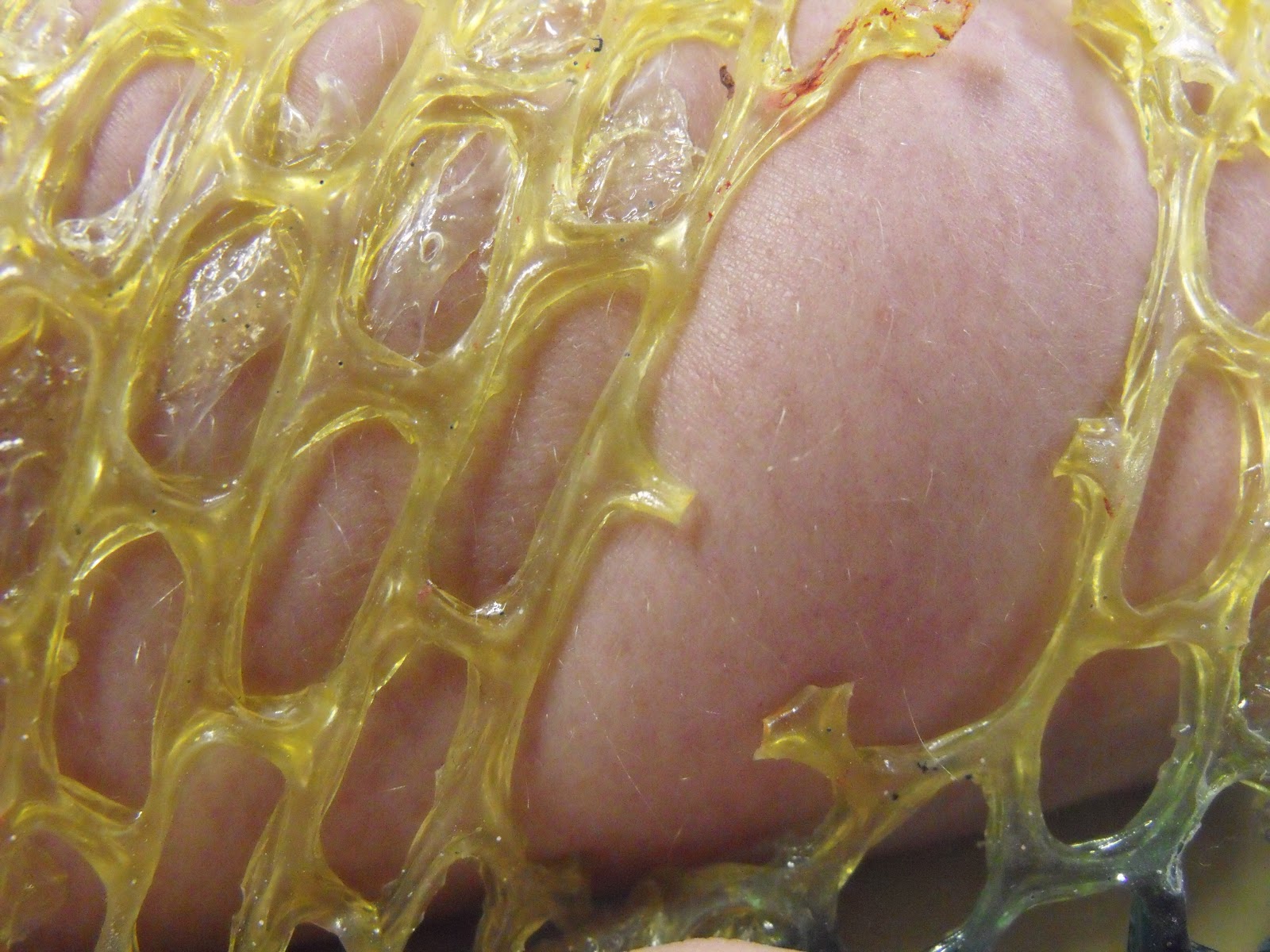
After making my latex samples i wanted to see how they worked as another material to cover the body leaving small parts visible or being opaque to see the body underneath. I liked the way the latex pulled and distorted the skin but also the colours and textures make it harder to see whats underneath. The texture of latex when stretched over the skin like tight clothing can sexualise something and make it body conscious like pvc clothing. The idea of someone being squeezed into tight latex like material and the way the skin has pulled in my pictures makes it awkward but in a funny way.


These are the ones i tried out today on arms and legs...


Today i did some further photographs of body parts and skin covered and changed with materials. My first idea came from Mari Iwaharas work using typography and language using the skin. I wanted to see what the outcomes were and the processes of concealing or obscuring body parts. Seeing parts of the skin and body isolated in one image can change your perception of where it is and
what it is. When i first saw Maris work it looked rude and made me unsure what parts of the body were used until you look closer, i think most people at first look of something thats obscure their mind jumps straight to something sinister or dirty. This instant judgement and perception when using skin and body parts i want to play on further.


These are my attempts with Chloe which were much more difficult than i thought they would be. A large part of the time we spent was actually figuring out where on the body and how, we then moved onto looking at natural shapes the body makes without using wire on them such as a C in the ear and a B in the nose. I felt this excercise helped me with my work, it made me be aware of communication with the body and how it can be changed.

Natural body forms:


Altered body forms:

X


N


I


Z


Y


D


H


M


Proxemics


 I first looked at body sculptures that could be worn or have the effect of being worn when they are static and cant be moved. I mostly worked with covering the face as it created anonymity of the person and gave them their own space. From having their own space they would then experience whether it had a positive or negative effect, if they felt claustrophobic and uncomfortable about others around them or (similar to when we all sat in our boxes) that it became comfortable having their own personal space that felt secluded and safe.


This then lead me onto proxemics and our own personal spaces. I made sketches similar to these but with a hole cut out for the person inside to see out of. This in turn allowed others to test the personal space of the participant and stand as close as they like with sole communication with their eyes which many people feel uncomfortable with eye contact. This also lead me onto making sketches of sculpture that could be worn as a way of keeping people at a certain distance that was comfortable or uncomfortable. Tomorrow I'm going to be making some prototypes of these and recording what i find.


This made me think about how we communicate and use our bodies to tell others about our social distances. Its within our culture in Britain to avoid human contact, someone sitting next to you on an empty train, standing too close when talking to someone and even shaking hands although its body contact there is still a fair distance between the two people. This is called haptics, non verbal communication involving touch for example when greeting someone. When someone is too close its also in our culture to be polite and move away or be quietly angry and annoyed by huffing or tutting in the hope they'll take the hint and move. Even in close situations like on a train or confined area everyone moves around awkwardly to get into a more closed off position that they feel slightly more comfortable in.

Tomorrow i want to make some body casts in closed and open positions wearing boiler suits which will change the body shape into a more unisex form that most people could fit into. From this i want to photograph and record other people trying to fit into the casts mimicking the body language. 


Tuesday, 5 March 2013

Manchester Trip

On this trip i was looking for artists that would assist me with my current project so mainly artists with interactive work or ones that look at the body conveying a message. In The Manchester Art Gallery there were quite a few that were interactive although a some of them seemed like they were for children. I saw the work of Rafael Lozano-Hemmer who gets the audience to participate and create their own image by putting their finger into a  hole that has a digital microscope inside and creates an image of your fingerprint repeated on a large screen. It syncronizes with your pulse and repeats images of other peoples fingerprints.

http://www.manchestergalleries.org/whats-on/exhibitions/index.php?itemID=73&tab=resource

'Rafael Lozano-Hemmer was born in Mexico City in 1967. He studied chemistry, before moving into the realm of visual art and now lives and works in Montreal.
Lozano-Hemmer creates artworks that depend on your participation to exist. This exhibition records your pulse, fingerprints, voice and image, and these recordings form the actual content of the works. The content is entirely "crowdsourced", to use internet terminology. In this sense the works are playful, open and inclusive.
However, there is also a more ominous or predatory nature at play. The works use biometric and surveillance technology employed by governments and corporations to profile, control and predict our behaviours in the name of efficiency or safety. These tools have built-in prejudices, as when they are used for ethnic profiling.
In an age of reality TV, mobile computing, virtual economies, Google street view and credit databases, Lozano-Hemmer sees technology as an inevitable part of our culture. His approach is to "misuse" the technology to create experiences of connection and complicity by using ambiguity, irony, repetition, performance and self-representation.
In creating poetic, critical forms of interaction, the works encourage the public to be an integral part of the art and reflect on our inescapable, playful and ominous, technological experience.
“In Recorders artworks hear, see or feel the public; they exhibit awareness and record and replay memories entirely obtained during the show. These works emphasize that absence and presence are not opposites, and that several realities co-exist at any given time."
Rafael Lozano-Hemmer

Pulse Index, 2010

Digital microscope, pulsimeter, plasma display, computer, custom-made software.
Insert your finger into the sensor and wait for it to detect your heart rate,
this may take up to ten seconds. When it is done, the system will display your fingerprint, pulsating to the rhythm of your heart beat, together with the recordings from the 508 previous participants. As more people try the piece your own recording travels upwards until it disappears altogether.'


Tuesday, 5 February 2013

Polyurethane Foam and Plastic

Ive been a bit confused on what to do for Alternative Miss World with my materials. Ive enjoyed using plaster but the weight of it probably wont work for my ideas as it needs to be light ish to stand up. My idea is to use a messy raw sort of material that can be cheap or look inexpensive, i want to pour this over my sculpture that will run onto the floor to hopefully give it some structure and hold it to the floor. These are some sketches of my ideas so far.


I like the effect plaster gives and like that it looks chalky and matte and also that parts are crumbling away and deteriating. However for the scale im wanting to make this i dont think it will work or stand up, the legs i made had to be stapled to the wall and still this wouldnt hold it for too long. I started looking into other materials that would be a lot lighter, i experimented with some latex but only in a 2d form so i need to try it on 3d surfaces to see how it looks. I liked the shiny rubbery surface it made when i mixed it with glitter, i want to use cheap tacky sort of materials like glitter etc.

My next idea was expanding foam as i could still use chicken wire to make the basic shape. Also after making the legs with plaster the effect it gave inside would be similar or stronger when using expanding foam which i liked.


The main artist i could think of that used foam was Folkert De Jong who puts pigment into the foam to colour it although it isnt expanding, the colours and textures remind me of cakes and sweets.


Folkert has also collaborated with fashion designer Walter Van Beirendonck, this may help if i decide to make a costume/sculptural piece.


Someone who uses polyurethane plastic is Nick Van Woert,  he uses historical sculptures and busts then covers with plastic to disfigure and cover the sculpture but also the way he lets the plastic sets then displays changes the gravity of the work.


These materials are normally used for casting, an artist using resin casting is Darren Lago he contrasts the material with the subject matter but i find his use of materials more interesting. He puts pigment into the resin using bright sweet colours then glass over the top. Another idea would be to make a cast using the material instead of pouring over something else.